

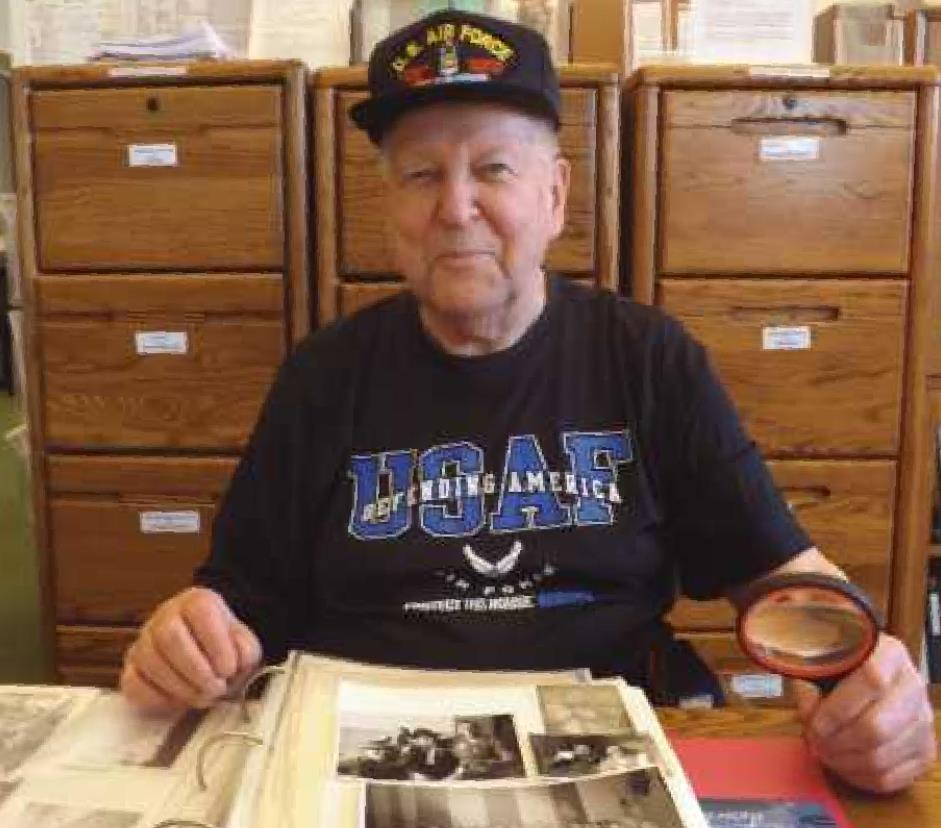
One of the ways Wood County recognizes its veterans is through the Perrysburg Way Public Library’s participation in the Library of Congress Veterans Project. The purpose is the preservation of veterans’ service memories.
Recently, the library recorded an interview with longtime Rossford resident, Lawrence Szczublewski, who served in the U.S. Air Force from 1951 to 1955. Mr. Szczublewski was stationed in Germany in the 1st Pilotless Bombing Squadron, part of the USAF guided missile program.
He was born in Toledo, September 14, 1933.
“Our home was over a grocery on Nebraska and Detroit Avenue,” he remembered. “My father’s grandparents came to America in 1894, forced out of Poland by the German government. Ethnic cleansing was going on long before the Nazis ever took over. One country or another was always trying to take over Poland–the Prussians, the Austrians, the Russians all were there at one time or another.
“My mother’s parents came in 1908. They had people in Toledo. When you look at these old neighborhoods in Toledo, you will find that they were people from the same villages in Poland. Both sets of my grandparents came from Znin.
“When I was little, my father worked on and off at Willys. It was the Depression and nothing was steady. Jobs were hard to come by, money was hard to come by–and three of us children to support.
“When I was 8 years old, Pearl Harbor was bombed. Going to church we heard sirens. People yelled, ‘We’re at war, we’re at war.’ I had a paper route. I went to Gerkee on Dorr Street where I got my papers. People were paying $1 for a paper when they sold for maybe five cents. My older brother Bob and I did well that day, although the money we made, as always, was given to mother.
“When I got a little older we moved to 1464 Pinewood, as the family expanded with my younger brothers, Paul and Jim. Later, a younger sister, Mary Ann, would come along. The war ration office was across the street from our house. There were coupons for tires, clothing, sugar and meat. But the war created work, and my parents took it.
“My dad got full-time at Willys–second shift–and mother worked in the sewing room first shift.
“Willys made Jeeps mainly, as well as rotor blades for helicopters, ammunition shells, crank and cam shafts and other war materials.
“At night you could hear the trains running back and forth. The main line was over Dorr Street. They would be carrying tanks and trucks shipping out to other points from Toledo and Detroit. All night long you heard hammering from the forge shops on Smead and Dorr, like Doehler-Jarvis or Bliss, making big guns and artillery pieces for the naval ships.
“There was a big marshaling railroad yard on Buckingham Street. Tanks would be loaded on flat cars and shipped overseas. Toledo was one of the top spots in the country for manufacturing. We also had Auto-Lite, Champion Spark Plug and DeVilbiss Company.
“With my parents working, we had money. We could actually buy new clothes and not have to take hand-me-downs from other families. I went to Indiana Elementary, across the street from our house. Later, I went to St. Teresa’s. In 1947, I started at Central Catholic and then Macomber opened and I graduated from there in 1951.”
Mr. Szczublewski enlisted in the service right after graduation.
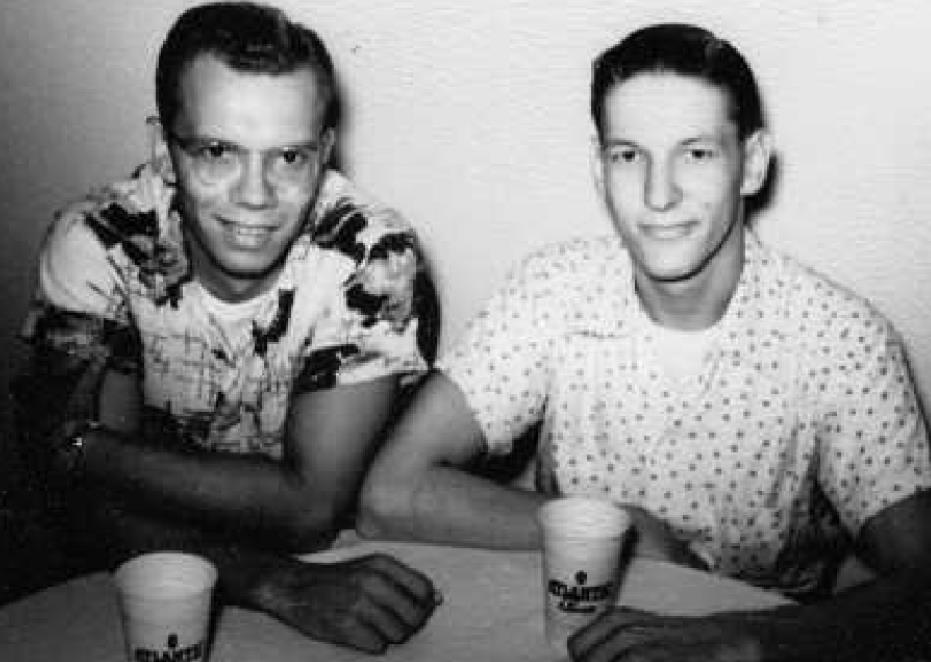
“I went looking for jobs, but there weren’t any, and the Korean War had started,” he said. “We knew we would be going in so my friend Bob Palowicz and I decided to enlist. It was either the Marines or the Air Force. We flipped a coin and Air Force won.”
Later his brothers would enlist, Bob going to Alaska and Paul to Korea.
Mr. Szczublewski and his buddy may hold the record for fastest induction. They went downtown for their papers and took them home to get signed by their parents. Both were 17. They brought the papers back and the recruiter suggested they get their physicals. They passed and were sworn in. They were told to go home and get clothes, and that night they were flying to Lackland Air Force Base in San Antonio, Texas, arriving early morning.
“I think my parents were happy to see me go,” he said, laughing. “As for us, we were stunned by the events of that day. No parties, no goodbyes. All of a sudden we are in boot camp in Lackland, living in a wood-frame tent with a wood floor.”
He was given some tests to see where he would fit. It would be guided missile electronics at Lowry AFB in Denver. “None of us knew where we were going or what we would be doing,” he remembered. “It was six days of class, eight hours a day. Air dynamics, jet propulsion, jet engines, everything to do with guided missiles. I spent a year at Lowry.”
Mr. Szczublewski was then sent to Cape Canaveral in Florida where live missile launches were underway. He was assigned to the 6555th Guided Missiles Wing, continuing training.
In spring 1954, the group shipped to Germany on the USS Harry Taylor. “There were, maybe, 1,800 guys on the ship. We hit a big storm. The tables in the mess hall had rails on them so the plates and silverware wouldn’t end up in your lap. Guys got sick.
“In the hold, we were five bunks high. If somebody up above you got sick, you got wet. I was still with my buddy, Bob, and a guy about 10 years older than us had told us to sign up for KP and eat all the time. That’s what we did; I was never seasick.
“Being young, you don’t realize what is really happening at the time until you are done with what you went through. I can see why the service loves young guys. They are flexible. It’s easier to put a gun in their hand and say ‘charge,’ where an older guy will hesitate to think about it.”
The group landed at Bremerhaven, Germany, and went on to Bitburg Air Base, a few hours away by train. They were assigned barracks, four men to a room.
“There was a lot of activity. Planes were taking off all the time. I was training every day. We had classes on how to act off the base and how to behave, what to eat. They explained exchange rates.
“At the noncommissioned officers’ club, you could buy a bottle of beer for five cents. Of course, we only made $75 a month. Still cheap, so guys would stay on base. You have less trouble that way. The Air Force knew what they were doing.
“On base, we used occupational money. Off base, we could exchange it for marks. Using occupational money kept money off the black market, although guys got around it. Cigarettes were 15 cents a pack. Guys would buy them, take them into town and exchange them for marks.
“The situation in Germany was tense,” Mr. Szczublewski said. “Thus the guided missile readiness. The Russians had already tried to take West Berlin. They blockaded land access, and we had to fly planes in with supplies. Eventually, they gave up and let us go in by land.
“Our missiles were just a threat. We never fired them. We would start the engines and check the hydraulics in the flaps and the rudders. An F-80 fighter would fly low over the launch area and simulate the path of the missile. A guidance system in the fighter acting as the missile was controlled remotely from the ground.
“I worked on the guidance system. I would take it apart and program it. A guy would send a signal to this computer remotely and make sure the frequencies were correct. Using an oscilloscope, I checked all the commands that it received were OK. Once adjusted, the next day we’d test it on the actual missile sitting on the pad.”
There was leisure too. On leave, Mr. Szczublewski visited Amsterdam and London. He also played on the base soccer team traveling to several other bases in Germany. “It was good duty.”
Mr. Szczublewski was offered a stripe to stay, but mustered out May 9, 1955. He worked for Western Electric for several years and later Houghton Elevator.
Mr. Szczublewski met his wife, Marilyn Zuchowski in 1960. Her father, Frank, was mayor of Rossford. After they were married, they bought a house in Rossford, raising four children. His wife died in 2016. “My kids are close, and I see them all the time.
“The service makes you or breaks you,” he said, summing up. “It was a learning experience. Every person should go in no matter if he just did a desk job. You meet people, and you make friends. You learn how to take care of yourself. You meet people from other parts of the world. And you figure out how to get along with them. I found I had greater respect for my parents and family than before I went in.
“I had no qualms about serving. This is my country, even though I am Polish. All I knew is that we were at war and we had a fight to do. And I volunteered to go.”
Richard Baranowski is a local historian and librarian at Way Public Library.